
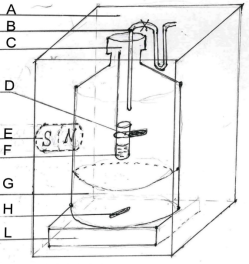
The aim of the work was the simultaneous determination of hydrocarbon biochemical oxygen demand - cBOD and nBOD (nitrogen) in the same water sample without using a nitrification inhibitor by the manometric method. Daily measurements of cBOD are determined by recording the pressure drop resulting from the absorption of carbon dioxide released by the oxidation of hydrocarbon organic matter by microorganisms with KOH (potassium hydroxide). Here, the processes of oxidation of mineral substances in water and especially the developing nitrification processes, which absorb oxygen dissolved in water and cause an additional pressure drop in the vessel, are a disturbing factor, for the measurement of which, in the daily 24-hour cycle of registrations, it is recommended to close the absorption hole of the vial with KOH for 8 hours. The 24-hour nBOD and cBOD results are calculated from the result of the pressure drop in these 8 hours. In the paper, in the form of a table, the detailed form of calculation of the recorded results of BODs at two pH-s of a natural water sample within 1-20 days is given. The possibility of anthropogenic impact assessment using this method is shown on the example of natural water. It is concluded that with the proposed method of measuring BODs records the complete and separate results of cBOD are recorded under conditions of developing nitrification in water. All information from both nitrification and BOD-full is recorded simultaneously, which gives a complete picture of the overall oxygen balance in the water. The proposed method is practically applicable and fully comparable with the results obtained by the standard manometric method.
| Published in | Modern Chemistry (Volume 12, Issue 4) |
| DOI | 10.11648/j.mc.20241204.12 |
| Page(s) | 82-88 |
| Creative Commons |
This is an Open Access article, distributed under the terms of the Creative Commons Attribution 4.0 International License (http://creativecommons.org/licenses/by/4.0/), which permits unrestricted use, distribution and reproduction in any medium or format, provided the original work is properly cited. |
| Copyright |
Copyright © The Author(s), 2024. Published by Science Publishing Group |
nBOD, cBOD, BOD Full, Method, Nitrification, Total Oxygen Balance
pH=7.0 | pH=8.3 | |||||||||
|---|---|---|---|---|---|---|---|---|---|---|
Column | 1 | 2 | 3 | 4 | 5 | 6 | 7 | 8 | 9 | 10 |
Bod1-20 | 8-hournBod | 24-hournBod | Bod full | Bod c | Bod Full st. | 8-hournBod | 24-hournBod | Bod full | Bod c | Bod Full st. |
1 | 0.09 | 0.39 | 0.60 | 0.21 | 0.15 | 0.03 | 0.18 | 0.27 | 0.09 | 0.63 |
2 | 0.18 | 0.63 | 0.99 | 0.36 | 0.45 | 0.09 | 0.36 | 0.51 | 0.15 | 0.78 |
3 | 0.24 | 0.75 | 1.35 | 0.60 | 0.99 | 0.15 | 0.45 | 0.69 | 0.24 | 0.91 |
4 | 0.27 | 0.81 | 1.14 | 0.33 | 0.66 | 0.15 | 0.66 | 0.93 | 0.27 | 1.05 |
5 | 0.27 | 0.84 | 1.14 | 0.30 | 0.79 | 0.30 | 1.11 | 1.35 | 0.24 | 1.29 |
1-5 | <-> | 3.42 | 5.22 | 1.80 | 3.00 | <-> | 2.76 | 3.75 | 0.99 | 4.68 |
6 | 0.30 | 0.90 | 1.14 | 0.24 | 1.11 | 0.45 | 1.56 | 1.65 | 0.09 | 1.65 |
7 | 0.30 | 0.96 | 1.20 | 0.24 | 2.07 | 0.60 | 1.92 | 2.01 | 0.09 | 1.89 |
8 | 0.33 | 0.99 | 1.26 | 0.27 | 1.41 | 0.69 | 1.98 | 2.04 | 0.06 | 2.07 |
9 | 0.33 | 0.99 | 1.26 | 0.27 | 1.53 | 0.63 | 1.80 | 2.04 | 0.24 | 1.95 |
10 | 0.33 | 0.93 | 1.26 | 0.33 | 1.41 | 0.57 | 1.56 | 2.13 | 0.57 | 1.65 |
5-10 1-10 | <-> <-> | 4.77 8.19 | 6.12 11.3 | 1.35 3.15 | 7.53 10.5 | <-> <-> | 8.82 11.6 | 9.87 13.6 | 1.05 2.04 | 9.21 13.9 |
11 | 0.30 | 0.84 | 1.20 | 0.36 | 1.41 | 0.48 | 1.26 | 2.10 | 0.84 | 1.71 |
12 | 0.27 | 0.81 | 1.26 | 0.45 | 1.38 | 0.36 | 0.99 | 1.83 | 0.84 | 1.59 |
13 | 0.27 | 0.81 | 1.23 | 0.42 | 1.44 | 0.30 | 0.90 | 1.71 | 0.91 | 1.44 |
14 | 0.27 | 0.78 | 1.20 | 0.42 | 1.32 | 0.27 | 0.78 | 1.32 | 0.54 | 1.29 |
15 | 0.24 | 0.66 | 1.11 | 0.45 | 1.17 | 0.24 | 0.69 | 1.23 | 0.54 | 1.02 |
10-15 1-15 | <-> <-> | 3.90 12.1 | 6.00 17.3 | 2.10 5.25 | 6.72 17.3 | <-> <-> | 4.62 16.2 | 8.19 21.8 | 3.57 5.61 | 7.05 20.9 |
16 | 0.21 | 0.57 | 0.84 | 0.27 | 0.90 | 0.21 | 0.51 | 0.90 | 0.39 | 0.99 |
17 | 0.18 | 0.54 | 0.81 | 0.24 | 0.81 | 0.12 | 0.27 | 0.66 | 0.39 | 0.66 |
18 | 0.18 | 0.57 | 0.81 | 0.24 | 0.75 | 0.06 | 0.24 | 0.54 | 0.30 | 0.63 |
19 | 0.21 | 0.57 | 0.84 | 0.27 | 0.72 | 0.09 | 0.24 | 0.54 | 0.30 | 0.57 |
20 | 0.18 | 0.54 | 0.75 | 0.21 | 0.72 | 0.06 | 0.18 | 0.45 | 0.27 | 0.45 |
15-20 | <-> | 2.79 | 4.05 | 1.23 | 3.90 | <-> | 1.44 | 3.09 | 1.65 | 3.30 |
1-20 | <-> | 14.9 | 21.4 | 6.48 | 21.2 | <-> | 17.6 | 24.9 | 7.25 | 24.2 |
Bod days | pH=7.0 | pH=8.3 | ||||||
|---|---|---|---|---|---|---|---|---|
Bod-full st. | Bod-full | nBod | cBod | Bod-full st. | Bod-full | nBod | cBod | |
1-5 | 3.84 | 5.04 | 3.15 | 1.82 | 6.63 | 6.42 | 5.77 | 1.65 |
5-10 | 6.78 | 6.72 | 4.83 | 1.89 | 9.45 | 9.30 | 7.47 | 1.83 |
1-10 | 10.62 | 11.76 | 7.98 | 3.78 | 16.08 | 15.72 | 12.24 | 3.48 |
10-15 | 6.60 | 6.30 | 4.23 | 2.07 | 5.64 | 6.21 | 3.75 | 2.46 |
1-15 | 17.22 | 18.06 | 12.21 | 5.85 | 21.72 | 21.93 | 15.99 | 5.94 |
15-20 | 3.96 | 3.54 | 2.28 | 1.26 | 2.46 | 2.37 | 1.11 | 1.26 |
1-20 | 21.18 | 21.60 | 14.49 | 7.11 | 24.18 | 24.3 | 17.10 | 7.20 |
RSD% | 3.4% | 2.0% | 2.3% | 11.0% | 6.2% | 5.3% | 9.0% | 1.3% |
Bod Days | №2- observation point | №3- observation point | ||||||
|---|---|---|---|---|---|---|---|---|
Bod-full st. | Bod-full | nBod | cBod | Bod- full st. | Bod-full | nBod | cBod | |
1-5 | 3.84 | 4.86 | 3.03 | 1.83 | 3.06 | 5.94 | 3.78 | 2.16 |
5-10 | 5.79 | 4.92 | 2.25 | 2.67 | 7.35 | 6.49 | 3.24 | 4.15 |
1-10 | 9.63 | 9.78 | 5.28 | 4.50 | 10.41 | 12.33 | 7.02 | 5.31 |
10-15 | 3.12 | 3.00 | 1.71 | 1.29 | 5.07 | 4.32 | 2.22 | 2.10 |
1-15 | 12.75 | 12.78 | 6.99 | 5.79 | 15.48 | 16.65 | 9.24 | 7.41 |
15-20 | 2.49 | 2.88 | 1.92 | 0.96 | 3.45 | 2.61 | 0.72 | 1.89 |
1-20 | 15.24 | 15.66 | 8.91 | 6.75 | 18.93 | 19.26 | 9.96 | 9.30 |
RSD% | 2.6% | 6.0% | 3.7% | 3.0% | 8.2% | 7.9% | 4.1% | 3.9% |
BOD | Biochemical Oxygen Demand |
cBOD | Hydrocarbon Biochemical Oxygen Demand |
nBOD | Nitrogenous Biochemical Oxygen Demand |
BOD-full | Biochemical Oxygen Demand Full |
KOH | Potassium Hydroxide |
CO2 | Carbon Dioxide |
PO | Permanganate Oxidation |
TH | Total Hardness |
| [1] | Konig A., Bachmann T. T., Metzger J. W., Schmid R. D. Disposable sensor for measuring the biochemical oxygen demand for nitrification and inhibition of nitrification in wastewater. Springer-Verlag, Appl. Microbiol. Biotechnol. 1999, 51, pp. 112-117. |
| [2] | Dhall P, Kumar R, Kumar A. Biodegradation of sewage wastewater using Autochthonous bacteria. Scientific World Journal 2012: 861903. |
| [3] | Water quality – Determination of biochemical oxygen demand after n days (BODn) – Part 2: Method for undiluted samples. Norm ISO 5815-2: 2003. |
| [4] | Geneva, International Organization for Standardization Publ., 2003, 13 pp. RD 52.24.420–2006. Biokhimicheskoe potreblenie kisloroda v vodakh. Metodika vypolneniya izmerenii sklyanochnym metodom (Biochemical Oxygen consumption in waters. The light-and-dark-bottle measurement procedure). Rostov-na-Donu: GKhI, 2006, 19 p. (in Russian) |
| [5] | Su JJ, Liu BY, Chang YC. Identifying an interfering factor on chemical oxygen demand (COD) determination in piggery wastewater and eliminating the factor byanindigenous Pseudomonas stutzeri strain. Lett Appl Microbiol, 2001, 33(6), 440-444. |
| [6] | Hur J, Cho J. Prediction of BOD, COD, and total nitrogen concentrations in a typical urban river using a fluorescence excitation-emission matrix with Parafac and UV Absorption Indices. Sensors. 2012, 12(1), 972-986. |
| [7] | Wood L. B., Hurley B. J., Matthews P. J. Some observations on the biochemistry and inhibition of nitrification. Wat. Res. 1981, 15, 543-551. |
| [8] | Feliatra F., Bianchi M. Rates of nitrification and carbon uptake in the Rhone River plume (Northwestern Mediterranean Sea). Microb. Ecol. 1993, 26, 21-28. |
| [9] | Grunditz C., Dalhammar G. Development of nitrification inhibition assays using pure cultures of Nitrosomonas and Nitrobacter. Wat. Res. 2001, 35(2), 433-440. |
| [10] | Water quality – Determination of biochemical oxygen demand after n days (BODn) – Part 1: Dilution and seeding method with allylthiourea addition. Norm ISO 5815-1: 2003. Geneva, International Organization for Standardization Publ. 2003, 15 pp. |
| [11] | Polak J. Nitrification in the surface water of the Wloclawek Dam Reservoir. The Process Contribution to Biochemical Oxygen Demand (N-BOD). Polish Journal of Environmental Studies. 2004, 13(4), 415–424. |
| [12] | Ostapenia A. P., Parparov A., Berman T. Lability of organic carbon in lakes of different trophic status // Freshwater Biol. 2009, 54, pp. 1312–1323. |
| [13] | Sabylina A. V., Lozovik P. A., Zobkov M. B. Water chemistry in Onega Lake and its tributaries. Water Resources. 2010, 37(6), 842–853. |
| [14] | Sullivan A. B., Snyder D. V., Rounds S. A. Controls on biochemical oxygen demand in the upper Klamath River, Oregon. Chem. Geol. 2010, 269, 12–21. |
| [15] | Rezvani H., Mirghaffari N., Marzban M., Marzban AR. Determination of biochemical oxygen demand (BOD) without nitrification and mineral oxidant bacteria interferences by carbonate turbidimetry. Research Journal of Pharmaceutical, Biological and Chemical Sciences. 2014, 5(5), 90-95. |
| [16] | Gorland J. H. N. Nitrification in the river Trent. Mathematical models of water pollution. M. Mir. 1981, pp. 201-228 (in Russian). |
| [17] | Vavilin V. A. 1983. Nonlinear models of biological purification and self-purification processes in rivers. M. Nauka. 1981, p. 158. (in Russian) |
| [18] | Sargsyan S. A. A method and adaptation for determining biochemical oxygen demand. Patent of RA. № 891Y G01N 33/00, registered in 12.02.2024 (in Armenian). |
| [19] | Lurye U. U.(ed.) Uniform methods for water analysis. Moscow, Khimia, 1971, 374 pp. (in Russian). |
| [20] | Lurye U. U.(ed.) Uniform methods for water analysis. Publ. 2, Moscow, Khimia, 1973, 376 pp. (in Russian). |
| [21] | Plakhinsky N. A. Biometrics. Moscow, MGU, 1970, 367 pp. (in Russian). |
| [22] | Ryzhakov A. V. Kinetic parameters of the transformation of nitrogen-contaning compounds in natural water. Environmental Chemistry. 2012, 21(2), 117-124 (in Russian). |
| [23] | Yurchenko V., Radionov M., Melnikova O. Kinetic parameters of nitrification in a water basin, which is a potable water source. Ecological Sciences. 2019, 1(24), 121-125. (in Ukraine). |
| [24] | Arutunyan S. A. Oganesyan R. O. Grigoryan V. G. Dynamics of changes in the quality of waters of the Razdan River. Arminian journal of ecology. 2002, (1), 107-114 (in Russian) |
| [25] | Kobelyan R. O. Assessment of the water quality of Hrazdan River according to microbiological indications. Biol. Arm. Journal. 2017, 4(69), 35-38 (in Armenian). |
| [26] |
Sargsyan S. A., Kobelyan P. O. Study of some hydrochemical indicators of water and the number of saprophytic bacteria in the autumn period along theriver Hrazdan. Water: Chemictry and Ecology. 2019, (10-12) pp. 149–153.
https://doi.org/10.18334/watchemec.12.121.149-153 (in Russian) |
APA Style
Sargsyan, S. (2024). A Method for Determination of Hydrocarbon and Nitrogenous Biochemical Oxygen Demands in Natural Waters by Manometric Method. Modern Chemistry, 12(4), 82-88. https://doi.org/10.11648/j.mc.20241204.12
ACS Style
Sargsyan, S. A Method for Determination of Hydrocarbon and Nitrogenous Biochemical Oxygen Demands in Natural Waters by Manometric Method. Mod. Chem. 2024, 12(4), 82-88. doi: 10.11648/j.mc.20241204.12
AMA Style
Sargsyan S. A Method for Determination of Hydrocarbon and Nitrogenous Biochemical Oxygen Demands in Natural Waters by Manometric Method. Mod Chem. 2024;12(4):82-88. doi: 10.11648/j.mc.20241204.12
@article{10.11648/j.mc.20241204.12,
  author = {Suren Sargsyan},
  title = {A Method for Determination of Hydrocarbon and Nitrogenous Biochemical Oxygen Demands in Natural Waters by Manometric Method
},
  journal = {Modern Chemistry},
  volume = {12},
  number = {4},
  pages = {82-88},
  doi = {10.11648/j.mc.20241204.12},
  url = {https://doi.org/10.11648/j.mc.20241204.12},
  eprint = {https://article.sciencepublishinggroup.com/pdf/10.11648.j.mc.20241204.12},
  abstract = {The aim of the work was the simultaneous determination of hydrocarbon biochemical oxygen demand - cBOD and nBOD (nitrogen) in the same water sample without using a nitrification inhibitor by the manometric method. Daily measurements of cBOD are determined by recording the pressure drop resulting from the absorption of carbon dioxide released by the oxidation of hydrocarbon organic matter by microorganisms with KOH (potassium hydroxide). Here, the processes of oxidation of mineral substances in water and especially the developing nitrification processes, which absorb oxygen dissolved in water and cause an additional pressure drop in the vessel, are a disturbing factor, for the measurement of which, in the daily 24-hour cycle of registrations, it is recommended to close the absorption hole of the vial with KOH for 8 hours. The 24-hour nBOD and cBOD results are calculated from the result of the pressure drop in these 8 hours. In the paper, in the form of a table, the detailed form of calculation of the recorded results of BODs at two pH-s of a natural water sample within 1-20 days is given. The possibility of anthropogenic impact assessment using this method is shown on the example of natural water. It is concluded that with the proposed method of measuring BODs records the complete and separate results of cBOD are recorded under conditions of developing nitrification in water. All information from both nitrification and BOD-full is recorded simultaneously, which gives a complete picture of the overall oxygen balance in the water. The proposed method is practically applicable and fully comparable with the results obtained by the standard manometric method.
},
 year = {2024}
}
TY  - JOUR
T1  - A Method for Determination of Hydrocarbon and Nitrogenous Biochemical Oxygen Demands in Natural Waters by Manometric Method

AU  - Suren Sargsyan
Y1  - 2024/11/29
PY  - 2024
N1  - https://doi.org/10.11648/j.mc.20241204.12
DO  - 10.11648/j.mc.20241204.12
T2  - Modern Chemistry
JF  - Modern Chemistry
JO  - Modern Chemistry
SP  - 82
EP  - 88
PB  - Science Publishing Group
SN  - 2329-180X
UR  - https://doi.org/10.11648/j.mc.20241204.12
AB  - The aim of the work was the simultaneous determination of hydrocarbon biochemical oxygen demand - cBOD and nBOD (nitrogen) in the same water sample without using a nitrification inhibitor by the manometric method. Daily measurements of cBOD are determined by recording the pressure drop resulting from the absorption of carbon dioxide released by the oxidation of hydrocarbon organic matter by microorganisms with KOH (potassium hydroxide). Here, the processes of oxidation of mineral substances in water and especially the developing nitrification processes, which absorb oxygen dissolved in water and cause an additional pressure drop in the vessel, are a disturbing factor, for the measurement of which, in the daily 24-hour cycle of registrations, it is recommended to close the absorption hole of the vial with KOH for 8 hours. The 24-hour nBOD and cBOD results are calculated from the result of the pressure drop in these 8 hours. In the paper, in the form of a table, the detailed form of calculation of the recorded results of BODs at two pH-s of a natural water sample within 1-20 days is given. The possibility of anthropogenic impact assessment using this method is shown on the example of natural water. It is concluded that with the proposed method of measuring BODs records the complete and separate results of cBOD are recorded under conditions of developing nitrification in water. All information from both nitrification and BOD-full is recorded simultaneously, which gives a complete picture of the overall oxygen balance in the water. The proposed method is practically applicable and fully comparable with the results obtained by the standard manometric method.

VL  - 12
IS  - 4
ER  -
Institute of Hydroecology and Ichthyology of the Scientific Center of Zoology and Hydroecology, National Academy of Science of Republic of Armenia, Yerevan, Armenia

Information



 Share This Article
 Twitter
 Linked In
 Facebook
 Copy
Copy Download